Understanding Audio Annotation: The Key to Accurate AI and Machine Learning Models
Table of Contents
- Transcription or Speech-to-Text
- Speaker Identification
- Emotion Recognition
- Sentiment Identification
- Acoustic or Sound Event Identification
- Audio Classification
- Speech Act Identification
- Language Identification
- Why Should We Care About Audio Annotation?
- Industry Applications of Audio Annotation
- How is Audio Annotation Better on Rabbitt AI?
- Conclusion
<a name="introduction"></a>
Introduction
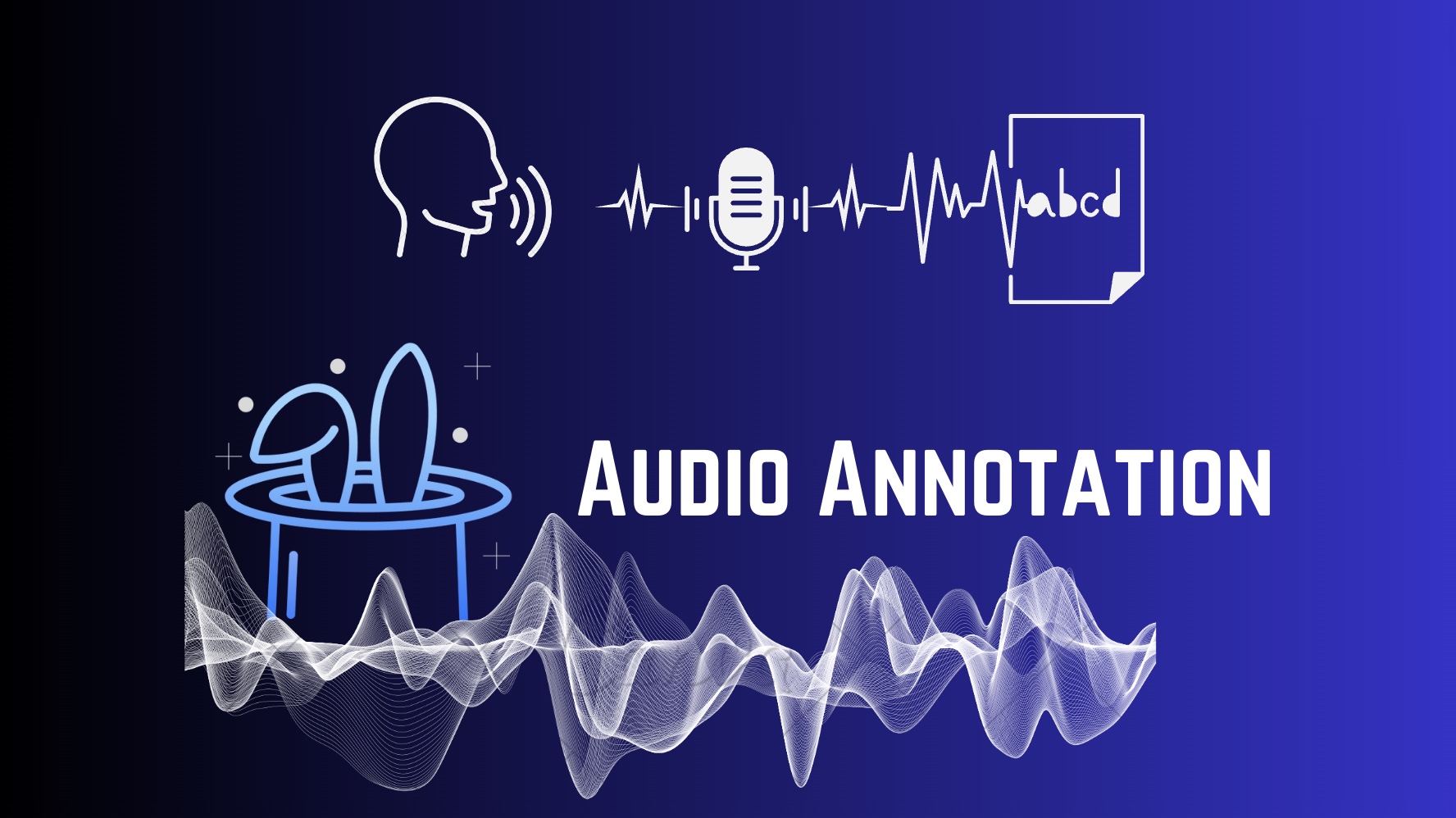
Audio annotation has been one of the most crucial components in developing intelligent systems that understand and interact with human speech in this rapidly advancing world of artificial intelligence and machine learning. What then is audio annotation? Picture yourself at a house party filled with activity, innumerable people talking all at once, music, laughter, and even some off-key singing. Take a computer to learn how to make sense of the noise. That is what audio annotation is all about—training AI to understand and process audio data.
Audio annotation is the careful labelling of audio data so it can be understood by machine learning models. It enables an AI system to detect, classify, and understand any sound, voice, or language. You teach a computer as if it were a dog, meaning not to sit, but how to tell Beethoven from the late-night hunting drumming of your neighbour.
Considering technological development, the high level of audio annotation accuracy and quality that comprehensively depicts intervention has mainly been applied in virtual assistants, transcription services, and automated customer service systems. The most beneficial functioning is given by these systems when the speech is tagged appropriately, yielding seamless and accurate experiences for the users. In this blog post, we'll cover the various kinds of audio annotation, their importance, and why Rabbitt AI is among the top service providers in the field.
<a name="what-is-audio-annotation"></a>
What is Audio Annotation?
What is audio annotation? Put simply, it's labelling audio data to make it understandable for machine learning models. It allows AI systems to identify, classify, and interpret many sounds, voices, and languages. All this becomes very critical in applications where audio data analysis has to be done, like in speech recognition, sentiment analysis, acoustic event detection, etc.
<a name="what-are-the-types-of-them"></a>
What are the types of them?
Herein are the types of audio annotations in:
<a name="transcription-or-speech-to-text"></a>
Transcription or Speech-to-Text
Ever wondered how your favourite podcast magically appears in article form the next day? That's transcription, or speech-to-text, in action. The technology translates spoken words to written text, easing the trouble associated with searching, managing, and distributing verbal content. Without it, you'd be doomed to a life of constant replays of voice messages, praying to catch that one word your boss muttered during the meeting.
<a name="speaker-identification"></a>
Speaker Identification
Has it ever happened that you are playing a conference call recording and you really want to know 'who said what'? Speaker Identification comes for your rescue here. This is a method that empowers an AI model in differentiating between the different speakers in an audio file—like putting corrective glasses on your AI ears, and everything becomes clear.
<a name="emotion-recognition"></a>
Emotion Recognition
Now, this is where it gets interesting. Emotion recognition allows AI to understand the emotions conveyed by spoken words: Is the speaker happy, sad, angry, or excited? It's like an emotionally intelligent therapist residing inside your AI. Imagine a customer service bot that detects frustration and responds with extra care. Amazing, right?
<a name="sentiment-identification"></a>
Sentiment Identification
Emotion recognition focuses on the feelings of the speaker, while sentiment identification tries to determine the general tone or attitude of the speech. The sentiment could be positive, negative, or even neutral here. This would be important for a company that would estimate customer satisfaction without creating many surveys.
<a name="acoustic-or-sound-event-identification"></a>
Acoustic or Sound Event Identification
How do smart appliances know if it is a doorbell or even a fire alarm? That's acoustic or sound event identification in action. It tags and recognizes events of nonspeech sounds that are very important for security and emergency response systems.
<a name="audio-classification"></a>
Audio Classification
Audio classification identifies the whole file with its content, be it music, speech, or ambient noise. This is quite useful in organising large audio databases to make searching through hours of recordings easier.
<a name="speech-act-identification"></a>
Speech Act Identification
Speech act identification does more than just transcribe the words; it considers a prior intention that comes before the words. Is the speaker requesting, ordering, or questioning? It is teaching your AI to read between the lines, truly grasping the purpose of the conversation.
<a name="language-identification"></a>
Language Identification
Language identification is the most required process in our multilingual world. This technique will help the AI model to recognize the language spoken in an audio file. Perfect for conversations switching between languages.
<a name="why-should-we-care-about-audio-annotation"></a>
Why Should We Care About Audio Annotation?
Why do we need audio annotations? Otherwise, your voice assistant may misinterpret the instruction "Directions to the nearest bakery" as "Dissections of the nearest bakery." Context is everything. Here is why audio annotation is important:
- Accuracy: Proper annotation makes sure the AI understands and responds to spoken instructions. Imagine your AI interpreting "Call mom" as "Order 50 pizzas."
- Smoothening: It makes AI-powered operations smooth and swift. No more screaming at your devices—unless that's your thing.
- Progress: Audio annotation paves the way for progress in voice recognition, transcription services, and other voice-dependent uses.
<a name="industry-applications-of-audio-annotation"></a>
Industry Applications of Audio Annotation
Audio annotation isn't just a niche technology—it's a cornerstone of numerous industries, driving innovation and improving services across the board. Here are some key industry applications:
- Voice Assistants: Voice assistants like Siri, Alexa, and Google Assistant rely heavily on audio annotation to understand and respond to user commands. Properly annotated data allows these devices to recognize different accents, dialects, and even individual speaker's voices, making interactions more personalised and effective.
- Transcription Services: The demand for transcription services has skyrocketed with the rise of podcasts, webinars, and online courses. Audio annotation transforms spoken content into text, making it accessible and searchable. This is crucial for creating transcripts of meetings, interviews, and legal proceedings.
- Customer Service: Automated customer service systems use audio annotation to handle calls efficiently. By recognizing speech patterns and identifying emotions, these systems can route calls to the appropriate agents or provide instant responses to common queries, enhancing customer satisfaction.
- Healthcare: In the healthcare industry, audio annotation helps in creating accurate medical records from voice notes and dictations. It also aids in developing AI models that can assist in diagnosing conditions based on audio symptoms, like cough sounds or breathing patterns.
- Security and Surveillance: Security systems use audio annotation to detect specific sounds like gunshots, alarms, or breaking glass. This technology enhances the ability of surveillance systems to respond promptly to potential threats, ensuring safety in public and private spaces.
- Media and Entertainment: From categorising music genres to creating subtitles for movies, audio annotation plays a vital role in the media and entertainment industry. It helps in managing vast libraries of audio content, making it easier to find and enjoy specific pieces.
- Education: In the education sector, audio annotation is used to transcribe lectures and create accessible learning materials. This technology supports students with hearing impairments and those who prefer reading over listening.
<img src="/blogimages/aa-blog-3.png" class="lg:w-2/3" />
<a name="how-is-audio-annotation-better-on-rabbitt-ai"></a>
How is Audio Annotation Better on Rabbitt AI?
The Rabbitt AI particularly excels in Audio annotation. Here's why:
- Privacy Fort Knox: In Rabbitt AI, your data is as safe as that last piece of chocolate in the office—fiercely. We take care of data privacy, ensuring no peeping neighbours get access to your sensitive information.
- Unmatched Accuracy: Our AI doesn't just work great; it works extremely well. We can tell the difference between a whisper and a sneeze to provide you with the accuracy needed for high-quality audio annotation.
- At Rocket-like Speed: Audio data is processed in a jiffy, faster than you have time to say "supercalifragilisticexpialidocious." With our AI, all data is quickly and efficiently processed at the speed of light.
- Curators AI – Your Personal Guru: Why pay a sales officer when you have Curators AI? This acts like a personal voice-controlled mentor that gives expert guidance without demanding a raise.
- Wallet Friendly: We deliver top-notch services without breaking the bank. With Rabbitt AI, you get a VIP experience at a fraction of the cost.
- Believe in Some Figures: Now, let's hit you with some numbers: 95% Accuracy: Our models achieve 95% accuracy, better than your best friend's advice on a good day. 200% Faster Processing Speed: We're not just fast; we're incredibly fast. No one likes waiting.
<a name="conclusion"></a>
Conclusion
Though perhaps not the sexiest of AI applications, audio annotation is definitely the behind-the-scenes hero that makes everything work. In Rabbitt AI, you have found a partner to offer you the best service while taking care of your privacy, efficiency, and budget. Why settle for average when you can have the best?
Let us plunge headfirst into the world of audio annotation with Rabbitt AI and make some noise—the good kind! Once again, stay tuned for much more insight, and remember that with Rabbitt AI, it's always the sky that's the limit. Experience teaches us that it is better to be safe than sorry.